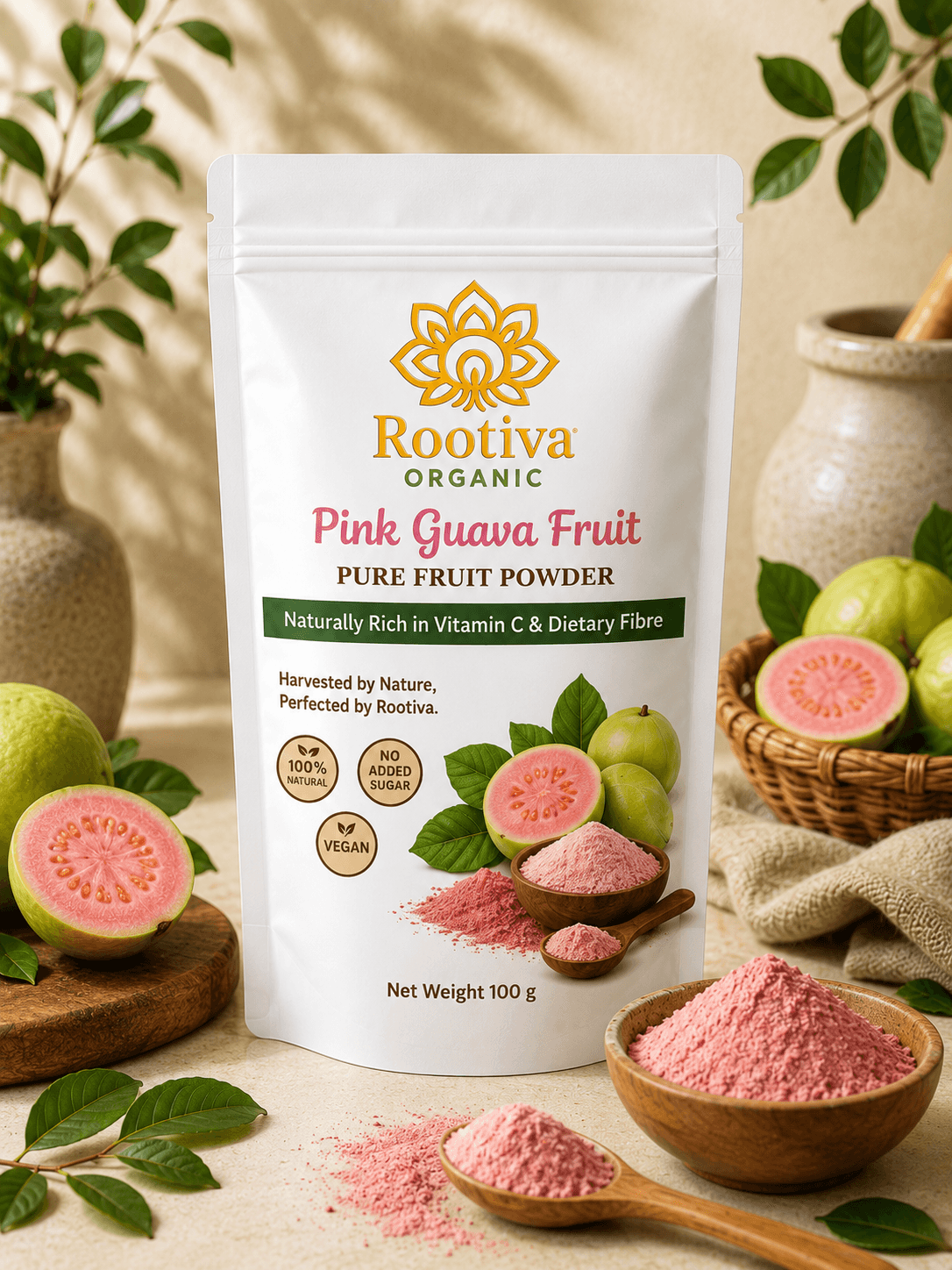
Short answer: Whole guava powder retains more fibre, lycopene, and pulp compounds than strained guava juice. For maximum nutrition, choose whole-fruit powder. Dissolve 1–2 tsp in 250ml water for a fibre-rich drink.
Guava powder made from whole dehydrated guava and guava juice are both derived from the same fruit — but they are nutritionally different products. The key differences come down to what is retained and what is lost in each production process.
Rootiva Organic pink guava powder is made from whole pink guava dehydrated at 45–70°C. Nothing is added — the entire fruit (skin, flesh, seeds, and pulp) is retained.
What guava juice contains
Guava juice is made by pressing or blending guava fruit and straining out the solids. The juice contains water-soluble nutrients (Vitamin C, some B vitamins), natural sugars, and water — but most dietary fibre is removed with the pulp during straining.
Commercial packaged guava juice adds further losses: high-heat pasteurisation (85–95°C) reduces Vitamin C, filtration removes remaining pulp, and added sugar or preservatives are common in mass-market brands.
What whole guava powder contains
Whole guava dehydrated and milled retains all components of the fruit. The only thing removed is water — fibre, Vitamin C, natural sugars, lycopene (in pink guava), seeds, skin compounds, and pulp polyphenols all remain.
Full nutrient comparison
| Nutrient / Factor | Fresh juice (strained) | Packaged juice | Whole guava powder |
|---|---|---|---|
| Vitamin C | Present — moderate | Reduced by pasteurisation | Present — concentrated |
| Dietary fibre | Low (solids removed) | Very low or zero | High (whole fruit retained) |
| Natural sugars | Present | Often with added sugar | Present — concentrated |
| Lycopene (pink guava) | Partial | Partial to low | Fully retained |
| Pulp compounds | Lost in straining | Lost in filtration | Retained |
| Shelf life | 1–3 days (fresh) | Months (preservatives) | 9–12 months (unopened) |
| Additives | None (if fresh homemade) | Often present | None — single ingredient |
When to choose powder over juice
- • Choose powder when fibre, lycopene, or year-round availability matters — smoothies, baking, mocktails, digestive health.
- • Choose juice when immediate hydration in large volume is the primary goal.
- • Best of both: Dissolve 1–2 teaspoons of pink guava powder in 250ml water for a reconstituted drink with pulp and fibre included.
FAQ
Is guava powder more nutritious than packaged guava juice?
In most cases, yes. Packaged guava juice is typically pasteurised at high heat (which reduces Vitamin C), filtered (which removes fibre and pulp compounds), and may contain added sugar or preservatives. Whole guava powder made by low-temperature dehydration retains more of the original fruit's nutritional profile — fibre, lycopene, and whole-fruit compounds included.
Can I make guava juice from guava powder?
Yes. Dissolve 1–2 teaspoons of guava powder in 250ml of water and stir or shake well. The result is a reconstituted guava drink with pulp and fibre included — closer to a fresh guava blend than commercially strained juice.
Does guava powder have more Vitamin C than orange juice?
Fresh guava is one of the richest fruit sources of Vitamin C — significantly higher per 100g than orange. Whole guava powder concentrates this Vitamin C. Exact values vary by batch and fruit maturity.
Is guava powder good for weight loss?
Guava powder retains the natural fibre of whole guava, which supports satiety and digestive health when used as part of a balanced diet. It is not a weight-loss product on its own. Use 1–2 teaspoons in smoothies or yogurt rather than consuming large quantities.
How much guava powder equals one fresh guava?
Approximately 2–3 teaspoons (6–9g) of whole guava powder reconstituted in water approximates the nutrition of one medium fresh guava. Exact equivalence depends on fruit size and dehydration batch.
What is the difference between pink guava powder and white guava powder?
Pink guava contains lycopene — a carotenoid pigment responsible for the pink-red colour. White guava does not contain significant lycopene. Rootiva Organic produces pink guava powder, which retains lycopene through whole-fruit low-temperature dehydration.